
Emil Milbrett
Hall of Fame – 2026
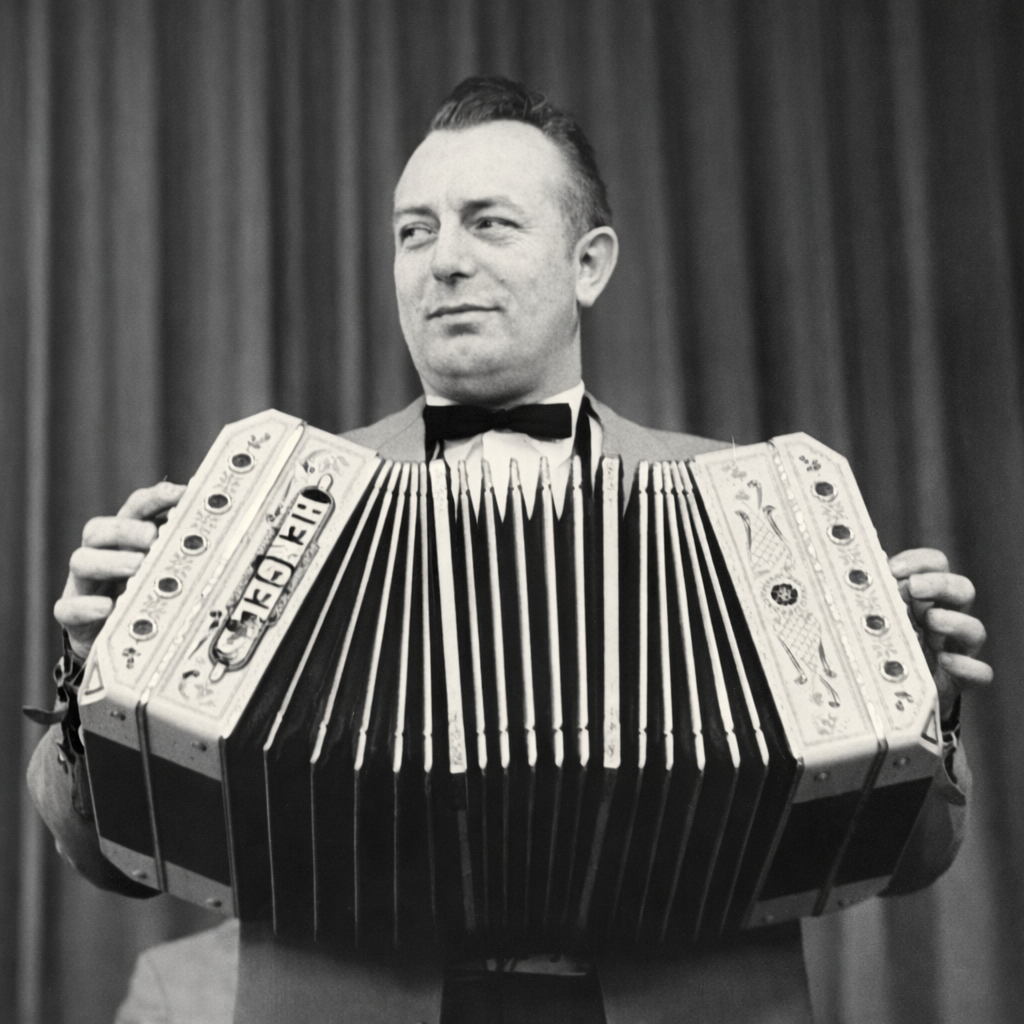
Emil Milbrett was born in 1926 in Brown County, Minnesota. From an early age, he had a natural gift for music, one that would eventually bring joy to countless audiences across the United States and Canada. Emil played the concertina with a warmth and melodic touch all his own, and he became one of the most recognized concertina musicians of his generation.
In 1947, Emil joined Harold Loeffelmacher’s Six Fat Dutchmen, one of the most celebrated “oom-pah” polka bands in America. For nearly twenty years, interrupted only by his service in the U.S. Army during the Korean War, he was the band’s featured concertina player, standing front and center at every performance. With his bright smile and easygoing presence, Emil was widely regarded as the face and the heart of the Six Fat Dutchmen.
The numbers speak for themselves: the band performed well over 300 shows a year, playing four-hour sets at ballrooms, dance pavilions, street dances, weddings, and music festivals throughout the Midwest, and from Canada to Texas. Emil performed on most of the band’s recordings, more than 800 songs released on RCA Victor and Dot Records. Those who knew the music could always tell when it was Emil playing; his style was unmistakable.
Remarkably, Emil never learned to read music. He learned melodies by ear, humming along until he had them down, then bringing them to life on the concertina with a swing that Harold Loeffelmacher Jr. himself remembered fondly. Emil was also a composer: he wrote the “Hayseed Waltz” and the “Yankee Waltz,” tunes that became beloved staples of the old-time repertoire.
After his years on the road, Emil continued to share his love of music. He and his brother formed the Bob Milbrett Band, playing at local venues and nursing homes, always bringing the old-time spirit to new audiences. He also worked for the School District in New Ulm, Minnesota, giving back to the community he called home.
It has been said that no other concertina player exposed the instrument to as many people as Emil did during his lifetime. He paved the way for other musicians in the Dutchman style and devoted much of his life to preserving the culture of old-time music. His legacy lives on in the recordings, the memories, and the countless lives he touched through his artistry.